

When the Empire Strikes Back...With a Memo.
We thought the concept of an evil empire was a thing of fantasy, but it's been very real - just operating in stealth mode behind unexciting bureaucracy and neutral-sounding think tank proposals.
Authors Note: this piece is intended as a simple reference for those wanting to come up to speed on one of the key ideological and strategic forces behind the democratic breakdown currently unfolding in the United States.
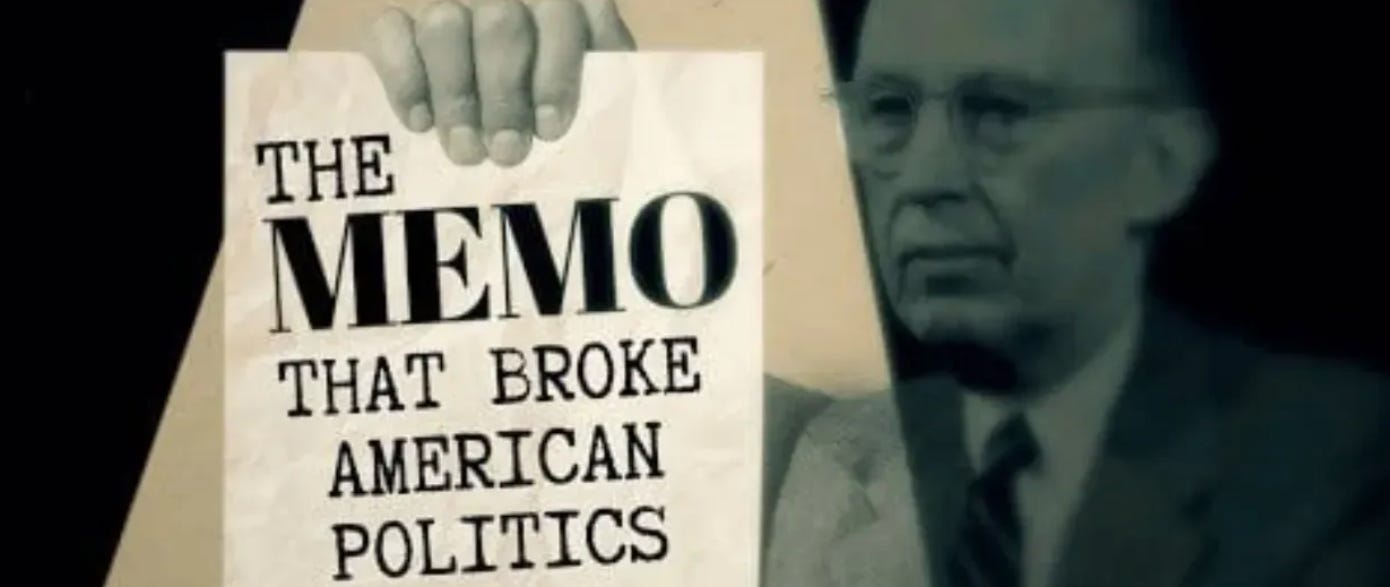
The Powell Memo of 1971
Anyone paying close attention to what’s been unfolding in the U.S. over the past 15 months and begins asking the question, “how did we get here?”, will eventually come across a critical historical document: the 1971 Powell Memo.
A 34 page memo outlining a strategy for corporations to consolidate and entrench their power, the Powell Memo marks the beginning of a systematic demolition of all the hard-won progress Americans made in the previous decades—labor rights, women’s rights, civil rights, education, healthcare, environmental protections—literally everything that made our country strong and foster a hope in a better future for all.
The story from 1971 until now is long and winding, and is covered in detail in The Lever’s Master Plan podcast, created by Academy Award nominee, David Sirota.
The purpose of this piece is to share a transcript of a short video I found to be an excellent, clear, accessible overview of the memo and its impact on our country.
Note: In the transcript she says the memo is 8 pages. The scanned PDF of the original memo was 34 pages, but it was in large font with wide margins and double spaced, so I’m assuming she read a copy that was formatted to eight pages.
Video Transcript
There’s a document in this country that most people outside of policy circles have never read. It’s not classified. It’s an 8-page memo written by a corporate lawyer in Virginia in the summer of 1971.
[T]hat memo is the single most important document in modern American politics because almost every political shift that you’ve lived through—Citizens United, the Federalist Society, the capture of the Supreme Court, the collapse of labor unions, corporate money in every election—was sketched out on 8 pages by one man.
It’s called the Powell Memo.
His name was Lewis Powell. He was a 63-year-old corporate attorney from Richmond, Virginia. He sat on the board of Philip Morris, the tobacco company, and spent years arguing in public that cigarettes did not cause cancer. He represented American corporations. He was a fixture of the Virginia establishment. And on August 23rd, 1971, he wrote a confidential memo to his friend Eugene Snyder at the U.S. Chamber of Commerce.
The memo was titled “Attack on the Free American Enterprise System.” It was marked confidential, which means it wasn’t meant for the public.
So fast forward two months. Richard Nixon nominated Lewis Powell to the United States Supreme Court. The memo wasn’t disclosed during his confirmation hearings. The Senate never saw it. The American public never saw it. Powell was sworn in as a Supreme Court justice in January 1972, six months after writing a private plan for corporate America to take over the country.
The memo opens with a warning. “No thoughtful person can question that the American economic system is under attack.” Powell argued that business was losing, losing the universities, losing the media, losing the younger generation, losing the courts. And the only way to reverse it was a coordinated multi-decade plan funded by corporations to take back every institution that shaped American opinion.
The language in the memo is the language of war… He used the words frontal assault, warfare, rifle shots, guerrilla warfare. He underlined the word survival. He said that corporate America had to abandon compromise and appeasement.
[T]his plan had four parts.
1. Capture the universities. Fund scholars. Endow chairs. Monitor textbooks. Pressure faculty.
2. Capture the media. Survey television content. Produce counter-programming. Build new press favorable to corporate interests. Hello? Are you listening?
3. Capture the courts. He wrote directly that the judiciary may be the most important instrument for change. Fund strategic litigation. Build legal organizations. Get corporate-friendly judges on the bench.
4. Capture the political system. Build lobbying arms. Create political action committees. Spend on elections at a scale that nobody has ever done before. Seriously.
That was the plan. Eight pages… Written in a matter of weeks.
So here’s what happened in the decade after the memo was written.
1972, the Business Roundtable was formed. A lobbying organization of Fortune 500 CEOs.
1973, the Heritage Foundation was formed. With seed money from Joseph Coors.
1973, the American Legislative Exchange Council (ALEC) was formed. That’s the organization that writes model legislation, which gets copy-pasted into state legislatures. Stand your ground laws. Voter ID laws. Anti-protest laws. Right to work laws. Literally all of it. Drafted by corporate lobbyists in a conference room. Then handed to state legislatures to introduce.
1977, the Cato Institute. Founded with Koch money.
1977, the Chamber of Commerce National Litigation Center. Now the most successful corporate advocacy group in Supreme Court history.
1978, the Manhattan Institute.
1982, the Federalist Society. That’s the organization that controls the conservative judicial pipeline.
Every single one of those organizations was a direct descendant of the Powell memo.
In 1971, there were 175 corporations… By 1982, there were over 2,400… But here’s the part that should stop you in your tracks...
In 1978, six years after he was sworn in, Lewis Powell wrote the majority opinion in a Supreme Court case called the First National Bank of Boston vs. Bellotti. That case is the first one that established that corporations have First Amendment rights, the right to spend money influencing elections.
Let that sit for a second:
The same man who wrote a private blueprint for corporate America to take over this country then went to the Supreme Court and wrote the ruling that legalized corporate political spending. He handed them the weapon he had designed in secret seven years earlier.
In 2010, the Supreme Court decided Citizens United v. FEC was going to be the ruling that opened the floodgates for unlimited corporate money in American elections. The Citizens United majority opinion cited Powell’s 1978 ruling over and over again, which means the case that broke American democracy in 2010 was built on the same foundation poured by a man who designed the entire plan in a private memo in 1971.
So I just want you to take a minute to think about everything you’ve ever seen break in your lifetime. Unions, public schools, local newspapers, state legislatures, the Supreme Court.
Think about every time you’ve wondered why this country keeps moving in one direction no matter who gets elected.
Now understand this, the people who built the machine that did that to you handed each other a memo in 1971. They passed it around corporate boardrooms. They funded the think tanks. They endowed the chairs. They built the courts. They trained the judges. They wrote the laws for 54 years. While most of us were just trying to live, they were executing a plan.
So no, it’s not you. You were never behind in an argument. You were playing a game. that somebody else had already finished designing.”
~ @ashleytheebaronness (original video)
Further Reading on the Powell Memo:
Powell Memo Text
For more background on Lewis Powell himself and the development of the memo, check out The Lever’s Master Plan Podcast, Season 1 Episode 3: The Powell Memo.
U.C. Berkeley Professor, Robert Reich, also discusses about the Powell Memo in the following essays and videos:
The Memo that Broke American Politics - (Raw Story)
The Worst Memo in American History - (Substack)
How the Corporate Takeover of American Politics Began - (YouTube Video)
The Horowitz Report (“The Other Memo”)
Just after my initial posting of this piece, it came to my attention via a subscriber that there’s another important document, the Horowitz Report, which built upon the Powell Memo.
I immediately DuckDuckGoed it, and one of the first things that came up in the search was the 2024 Atlantic article, titled “The Other Memo.” In its opening, it notes:
Powell certainly inspired Charles and David Koch and led the right’s leading donors into the fight. The courts, Powell’s memo presciently observed, provided “a vast area of opportunity” if “business is willing to provide the funds.” Then, after Richard Nixon named Powell to the bench, Powell delivered Big Business and the right wing a series of victories that unshackled wealthy donors, awarded First Amendment rights to corporations, helped curtail enforcement of the Voting Rights Act, and dramatically altered affirmative action.
Yet it took another memo to place conservatives on a different and more successful path that would alter the power dynamic in America forever. If you want to understand how the right captured the courts, how the conservative activist Leonard Leo became the most powerful man in the country, why the Federalist Society’s turnstile for conservative judges, lawyers, and professors came to exist, the place to start isn’t the Powell memo. It’s the Horowitz report, an almost completely unknown follow-up to Powell written by Michael J. Horowitz, a onetime liberal Democrat who turned to the other side. With the exception of a 1980s law-review article by Oliver Houck, an early-1990s report by the Alliance for Justice, and two tremendous academic books on the legal right from more than a decade ago by Ann Southworth and Steven M. Teles, it might not have been known at all.
You’ll notice that The Atlantic essay frames the Horowitz Report as if it reveals a completely missing piece of the story. I agree that it is a lesser-know but pivotal document. But I see it less as a replacement, and more as a layer that reinforces and operationalizes the “capture the courts” goal of the Powell Memo.
Another way to frame it: if the Powell Memo was the high-level strategic vision for the corporate capture of U.S. government and society, the Horowitz Report translated the “capture the courts” goal into an implementation plan for building the legal pipeline that figures like Leonardo Leo and the Federalist Society used to reshape the federal judiciary system.
Further Reading on the Horowitz Report:
“The Other Memo,”, (The Atlantic, July 30, 2024)
“Horowitz report is damning for the FBI and unsettling for the rest of us,” (The Hill, December 9, 2019)
Simple things to protect democracy and the planet

~ About ~
Peaceful Return is a newsletter born out of the urgency to resist the fascist descent of the United States. Drawing from history, psychology, myth, and religion, it seeks to understand the roots of what we are facing—late-stage empire, collective trauma, moral inversion, and the corrupting force of concentrated power—and identify pathways to a better future.
The “Return” in Peaceful Return points to the need to return to our true nature—before imperial, violent narratives severed us from our basic mammalian birthright: the felt sense of worthiness to be alive. The journey is one of casting off the shame imposed on us from above—by those obsessed with power, domination and hierarchy—and reclaiming this birthright.
The “Peaceful” part indicates the intention of avoiding harm to others in the process. However, the journey is not easy. It requires a relentless resistance to every morally inverted system or thought structure that places power, property and profit above life, love and people.
~ Alternative Way to Support ~
For those that are overwhelmed with too many subscriptions, you can make a one time contribution at my “Buy me a Coffee” link. As an independent artist with minimal “day job” support, every little bit helps me keep going.


While the 1971 Powell Memo became the blueprint for the Heritage Foundation, another influential memo known as the 1980 Horowitz Report, did likewise for the Federalist Society. These were essentially a corporate declaration of war on the middle class.
Chilling! Out of the shadows, now we see them clearly in the light of day😈