
Countering Thielism During the Fall of the U.S. Empire
Naming the enemy, mapping the resistance, and the exodus to a better future

Peaceful Return is a newsletter born out of the urgency to resist the fascist descent of the United States. Drawing from history, psychology, myth, and religon, it seeks to understand the roots of what we are facing—late-stage empire, collective trauma, moral inversion, and the corrupting force of concentrated power—and identify pathways to a better future.
“Common Good” vs. Greater Collective Good
I thought I understood the major authoritarian ideologies driving so much of current U.S. policy—Christian nationalism, white supremacy, imperialism, corporatism, technofuedalism. While different in their specific end goals, they share a common pattern: a belief in concentrated power, rule by a select few, and a willingness to dismantle the democratic consent of the majority to get there.
This week, I came across another intellectual ideology that may sit beneath or alongside many of these: post-liberal “common-good” Catholicism.
In a recent piece by Dissent in Bloom that documents the long-game that people like Peter Thiel, Steve Bannon, Marc Andreessen, and Heritage Foundation leaders have been playing for decades, she describes the ideology:
“The common good” is the central organizing idea of a political movement called postliberal common-good Catholicism, and it has a very specific meaning: that liberal democracy has failed, that individual rights have atomized society, and that the state must be redirected by a counter-elite who will impose a moral order from above, whether the public asks for it or not.
What immediately stood out to me is that within the name itself is one of fascism’s most powerful tactics: the inversion of language.1
“Common good” evokes a sense of a greater good for the majority of humans. But in practice it points towards the opposite. Never in the history of the world have authoritarian approaches founded in religious or ethnic supremacy produced a collective good—only good defined by and for a small elite at the expense of the humanity, dignity and free will of the larger population.2
Thielism
I’ve been searching for a term that captures the broader pattern across these ideologies.
“Sauronism” was my first impulse. It’s morally unambiguous and captures the logic of absolute domination and control at the expense of beauty and life that we are now facing. But it lives in a world people perceive as fiction.
“Thielism,” on the other hand, is grounded in a living figure who openly expresses authoritarian visions and whose data analysis company, Palantir—named after the seeing orbs used by Sauron in The Lord of the Rings—has become embedded within the AI-powered surveillance and military state.3 While Thiel’s particular vision may be more secular than that of Christian Nationalists, it captures core elements:
Concentrated power in the hands of a small elite without democratic consent
Structural and systematic dehumanization of the many, who lack voice or freedom to influence the system itself.
Extraction from the powerless to benefit the lives of the few
Relegation of nature, women, children and everything that is life-giving and of the earth, in service of technological white male supremacy.
Willingness to destroy the earth for power.
Violent surveillance and enforcement to maintain a rigid hierarchical system.
It’s important to keep in mind that the number of people actually advocating for these frameworks—whether true believers or opportunists—is actually quite few. (I attempt to summarize the key players and make ball park estimates of their numbers in this essay.)
The Nameless Resistance
Meanwhile, the vast majority of people in the U.S. will suffer under the dystopian future that Thielists are pushing for. The majority also have a moral compass that says, “Even if we did benefit personally, we would not knowingly support it because of the vast harm it does to everyone else, to nature, to animals, to ecosystems, and to the planet.”
Many of us also understand that late-stage capitalism, out-of-control monopoly-power, and the hyper-capitalist vision of these people will lead to our species’ extinction through AI energy consumption alone, if nothing else.
The stakes are existential. It is more urgent than ever that the true side of “good,” the diverse masses across classes, ethnicity, genders, professions, social justice causes—those 85% of us who want a better future for the planet and all living creatures—get way more unified and organized.4
The empire is falling. That we cannot stop. But we can influence what comes after.
To create a resistance powerful enough to counter Thielism, we need to merge much of the efforts behind climate awareness, ICE resistance, labor movements, women’s rights, BLM, and Occupy under One Big Umbrella.
Perhaps we call this Humanism, the Pro-Humanity Movement. Or perhaps we don’t need a name at all—for anything we name becomes vulnerable to their inversion of meaning tactic.
Mapping the Landscape
To get oriented, I’ve been trying to understand the landscape as it currently exists. Below is a mapping of the different forms of resistance I’ve been tracking online and in person. (For a map of Thielist players: simple summary here and detailed summary here.)
It’s not meant to be exhaustive, but to serve as an initial framework to view the situation holistically— to inform our strategy and where to put our time, energy and money.
Online Communication
Many of us are sharing info on line about what’s happening. This is useful, but some types are more helpful than others.
Reactive Outrage Cycles of the latest tragedy coming out of the White House often misattribute the blame solely to Trump → we need far less of this. These posts often unintentionally propagate regime messaging for clicks.
Online information sharing helps spread awareness and equip us with real time information of what’s unfolding → we need this but often leads to overwhelm without sharing paths to action
Deep, analytical writing provides context, historical data, useful frameworks and clarity, connecting the dots of the bigger picture and trajectory we are on → this helps educate the already awake and can also lead to overwhelm if not paired with action.
Critiques and rally cries with searing moral clarity that creates clear cognitive framing, sets boundaries and keeps the Overton Window open to morality, sometimes even with humor → deeply grateful for these invaluable pieces.
Visions of alternative futures to the trajectory we are on → there are people writing about this (they seem to to be converging on small local self-sufficient communities); we need far more of this to counterbalance the clear vision Thiel and his allies have already been building.
Concrete solutions to achieve a better future → extremely helpful, we need much more of this to build the people power required to create viable alternatives.
One of the downsides of online organizing is the information silos created by the algorithms, where the same groups uplift each other’s work without reaching or converting new people. This can also be a strength, though, when it leads us like-minded people toward real life solidarity and action.
In Person Organization
On the ground, there are signs of real movement as well, often inspired and directed from online information.
Protest infrastructure is growing - mass protests are legal, get people together, and build solidarity. But they don’t yet interrupt power. This may be changing, however, as No Kings, Indivisible, Move On, Greenpeace, Women’s March and 50501 are backing the labor movements organizing a General Strike on May 1st.
Upsurge in Labor organizing and DSA/Socialism activism, building solidarity across classes and industries. (DSA, Sunrise Movement, MayDay Strong, Power in Numbers)
Coalitions are forming across the labor groups and larger protest movements, all converging on May 1st.
But much of this is still early, slow and messy.
The Tension
The question I keep coming back to is: where do the awake, aware and motivated focus our energy (aside from daily survival)? These are the three general categories of action I find myself constantly (and frantically) engaging in:
Collaborating across groups on a strategy and push towards collective economic action → this can happen online, internationally, and in person.
Taking imperfect action now, even when there isn’t a cohesive strategy yet → in person, phone, zoom planning, etc.
Trying to reach the still-sleeping but morally aligned people who may be mobilized once they understand what’s happening.
There are real benefits from having a level of clarity and structure—a decision framework for prioritizing resources across education, strategy, mobilization, coordination, and building. It conserves energy and minimizes futile efforts.
But too much structure and centralization can also:
Silence emergent voices, suppress intuition, and delay the ability to make strategic pivots based on new information.
Make the movement vulnerable to coordinated attacks from the Thielists who will move to crush anything that looks like a genuine threat to their power.
Make the movement vulnerable to corruption from within as power centralizes
Decentralization protects movement from corruption or infiltration, but can limit scale and coordination.
So what does the balance look like? Are we still in the messy uncertain phase — too early on in the revolution for coherence?
A Pro-Humanity Roadmap
Where ever we reside in the grand arc of this moment, we won’t know until hindsight. But one thing is clear.
The socialist, leftist, peaceful, pro-humanity, pro-environmental movements in the U.S. must move to rally behind a collective vision and strategy—now.
Centralized Hub Led By New Voices
We need a loosely organized central hub of all the organizations, managed democratically, to coordinate us all behind a vision/goal and a basic strategy to get there. We have existing infrastructure with No Kings and 50501 being made up of a large umbrella of groups like Indivisible, Move On, Greenpeace, Women’s March, Jewish Voices for Peace, and DSA. We need to fold in more and start aligning an coordinating movement towards real action.
We need representatives from marginalized communities at the helm—not to meet some DEI quota or for feel-good optics, but because indigenous, marginalized, neurodiverse communities are literally the missing piece, the antidote. In fact, their absence is a strategic failure that produced the crisis we’re in. Among other things, they bring wisdom around organizing within resource constraints, systems analysis, and connections to the land that many of us transplants from feudalistic Europe lack. This is not about creating a new hierarchy, this is about bringing things back into balance.
The Goal is Total System Overhaul
Gradual reform under the current system cannot be our end game. Yes, getting more mayors and representative like Zohran Mamdani, AOC, and Bernie Sanders into office matters. Having some sane, mostly uncorrupt people within the institutions is a part of the plan.
But it’s not THE plan. And it’s not where THE change will come from.
We need to be clear: changing the system from within is not a coherent end goal.
Not only does the left—for very legitimate moral reasons—lack the money and resources to change the regime from within in the timeline required. We wouldn’t want to anyway for a couple of reasons:
The system is not worth saving. There’s no negotiating with fascists, as we’ve seen over the past 50 years.
Once inside, one becomes compromised. If the left actually gained control over the levers of power sufficient to enact its vision, it would no longer be true left. It would be just another version of concentrated power. (Think Boromir from LOTR)
The change will and must come from the people—from the ground up, the way anything of substance and lasting value is ever created. By people for people. Not by systems and corporations for profit and property accumulation.
Here’s a simple articulation of a potential goal we could rally around:
Independence from the current economic system that runs on a fundamentally flawed algorithm: one that prioritizes profit, power and property above people, life, and nature.
It’s from that faulty base that every other known atrocity stems. There’s no reform of a system that is founded on what can only be called inhumanity. Only total system overhaul that rewrites the founding base code will get us off this death march.
The Vision IS the Strategy
The remarkable thing about ground-up revolutionary movements is that the means are the ends. The strategy—the process by which we transform the current economic system—is itself the embodiment of the vision for what replaces it. We don’t need to seize the levers of power, as some might still believe—we need to live it and be it now.
Here’s what it means practically.
The goal, as articulated above, is an independence from the economic system that puts property rights over human rights, that protects wealth over human dignity, that grants freedom to some and not to others based solely on where they were born.5
To achieve this, two things are required:
withdrawal from the current system, and
creation of independent local systems of food, water, energy, shelter, internet, banking, medicine—Quaker-style.
These two things are the embodiment of the end goal of independence.
Withdrawal
Withdrawal from the violent system is one of the most underutilized leverage points available to people to counter the dystopian Thielist vision. It’s our labor and consumption that props it up, and withdrawing from it is where our power resides.6
Imagine millions of Americans withdrawing their money from big banks, their investments from the stock market, their data from big tech, their attention from social media, their consumption from monopolies, and their participation in the corporate economy. The last, withdrawing labor, is the most difficult and requires the creation of infrastructure (mutual aid, backup food/water/energy systems) to protect people as they leave the system. But the others we can start doing now.
The price we pay for much of this is some inconvenience—and yes, varying degrees of material risk. But if we cannot, for example, migrate out of the Google matrix or Facebook in the name of preventing f-sc-sm because it’s inconvenient, then we are facing an irreconcilable situation. I refuse that assessment. I deeply believe that if people truly understood the stakes they would exchange phone numbers with all their Facebook friends, move their groups to Signal or Discord, and delete the app by morning.
Which leads us to a core tactic:
Education
Education is not the only tactic, of course, but it is another powerful leverage point because it precedes and supports so many of the other collective actions.
Mobilizing everyday people—inspiring them to want to devote even an hour a day to this migration or “exodus”—requires understanding. Seeing clearly is foundational and makes everything else easier. When people see the connection between social media, surveillance, monopoly control, fascism, and AI data centers accelerating climate collapse—moving off Facebook becomes a no-brainer. The hassle of changing banks accounts and auto pays to a credit union suddenly feels small compared to the nightmare of a Thielist world.
We need massive resources devoted to educating the average American about two things:
The actual physical reality of the climate collapse timeline we are on, and how this ties into capitalism and its end-stage fascist form of an AI surveillance police state where none of us are free and our grandchildren may not live to 2100.
The best move for the 85% of us who want to preserve life on earth is to work on something like a five-year plan to become independent of corporate America and the federal government.
The education, of course, needs to be tailored towards the community. For me, living in an environmentally aware city, talking about nature loss will be a key motivation factor. Data centers going up nearby could be the talking point for somewhere else. But the point is to draw the connections across them all, communicate the timeline of the converging crises, and present the clear goal of independence as the solution to saving humanity and the earth from utter destruction by Thielists. (Don’t worry, we don’t have to call it Thielism if the word doesn’t resonate. Technofascism is fine too)
Clarity of Goal → to Clarity of Action
The goal is for the American people to become independent of the corporate-captured federal government, which is already abandoning them, and create self-sufficiency through mutual aid, co-ops, parallel institutions, local banks, and credit unions.
From clarity comes focus. For those already awake and mobilized, we don’t need a top down management structure for the resistance. We just need a bit more cohesion and for the social movements to agree on the simple shared end goal (independence). From there, everything we do—as individuals or as organizations—aligns more naturally without constant coordination, because everything we are working on is in service of that clear goal.
States and local authorities may provide insulation. AOCs, Bernies, Mamdanis may help provide cover. But most of this will be carried out by grassroots organizers and ordinary people opting out of this ouroboros-shaped system—and back into humanity.
A Concrete Action Step - May 1st
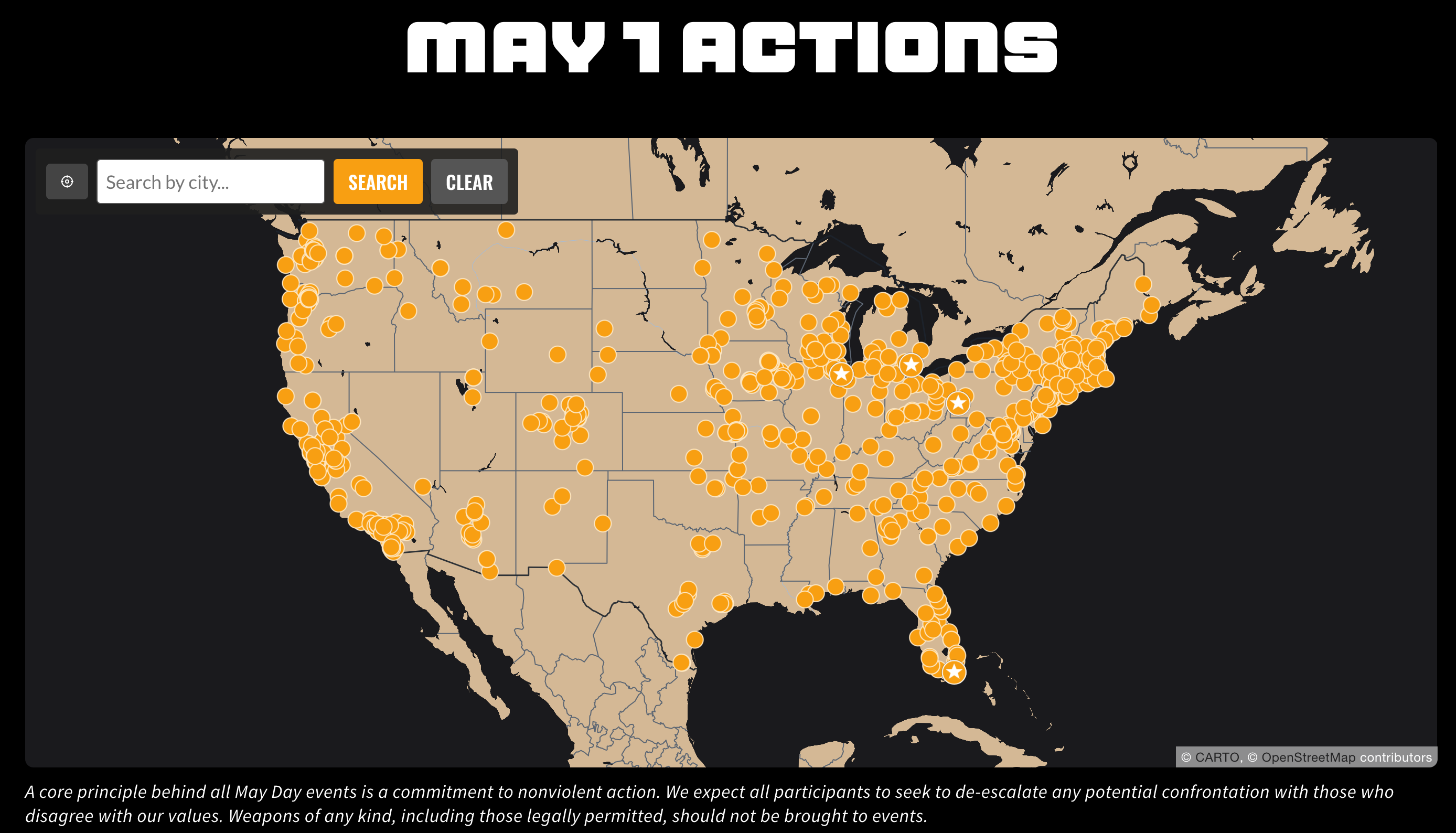
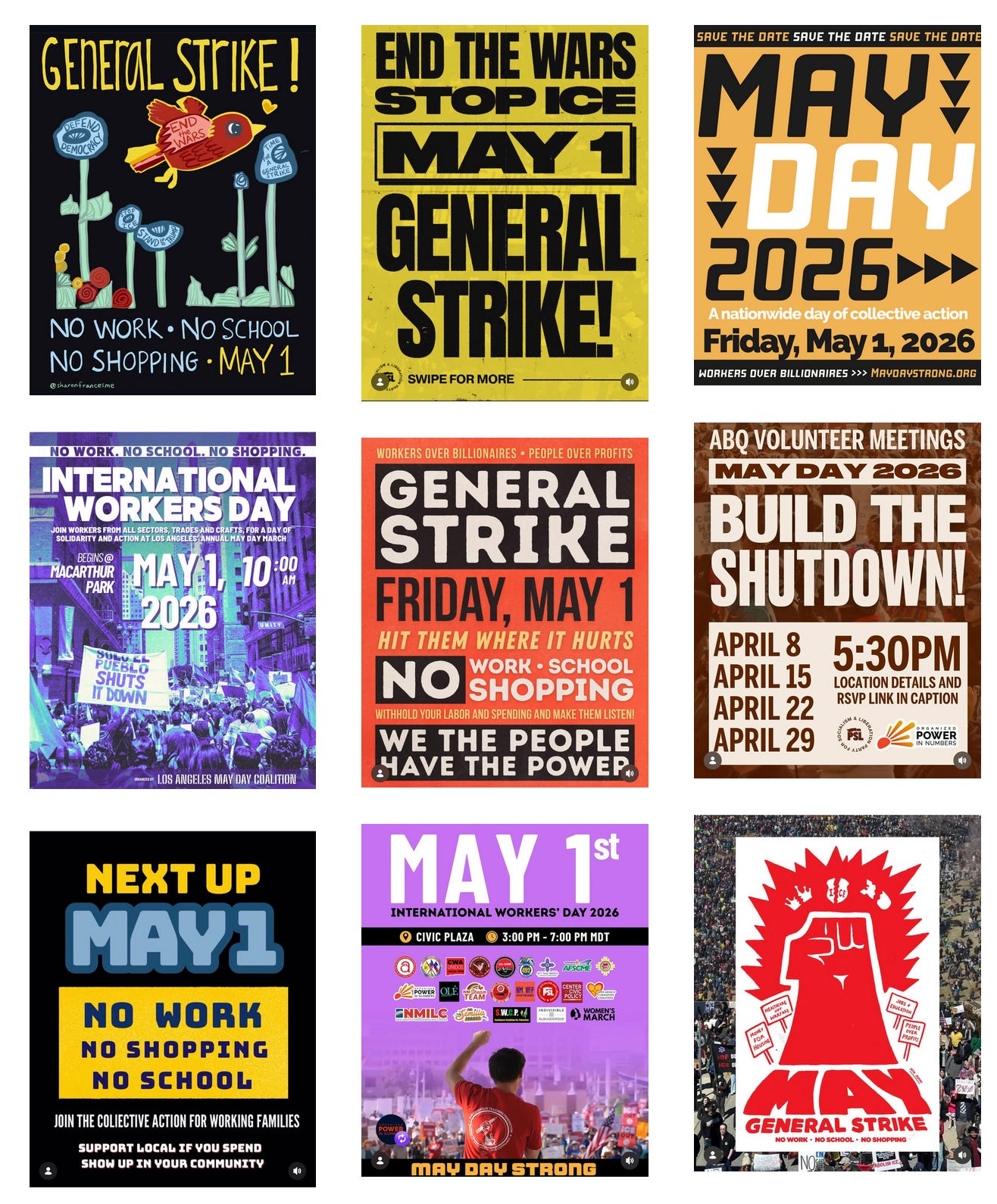
There’s an upcoming day of action gaining real traction — a one day General Strike on May 1st, International Worker’s Day. No work. No shopping. No school. This is a step towards liberation and a first flex of the collective power of withdrawal.
Led by labor groups like May Day Strong and Power in Numbers, and backed by large coalitions like No Kings, 50501, Indivisible, Women’s March, Greenpeace, Jewish Voice for Peace, and Move On, this has the potential to send a clear message: the American people are willing to make sacrifices for the greater good of humanity.
Check out the map for a local event near you, or create your own on Mobilize. Sign up with May Day Strong to learn more about organizing, or join your local DSA, 50501 or Indivisible chapter.
Additional Reading:
Ideas for Individual and Community Action (by me, with links to many other orgs)
A Cautionary Tale of a People’s Movement (by Ron Placone)
We Should Not Fear Tyrants; the Tyrants Should Fear Us (by Caitlin Johnstone)
Peter Thiel’s Palantir just Published its 22 Point Manifesto (by Dean Blundell)
~ About ~
The “Return” in Peaceful Return points to the need to return to our true nature—before imperial, violent narratives severed us from our basic mammalian birthright: the felt sense of worthiness to be alive. The journey is one of casting off the shame imposed on us from above—by those obsessed with power, domination and hierarchy—and reclaiming this birthright.
The “Peaceful” part indicates the intention of avoiding harm to others in the process. However, the journey is not easy. It requires a relentless resistance to every morally inverted system or thought structure that places power, property and profit above life, love and people.
~ Alternative Way to Support ~
For those that are overwhelmed with too many subscriptions, you can make a one time contribution at my “Buy me a Coffee” link. As an independent artist with minimal “day job” support every little bit helps me keep going.

FootNotes:
A great example of inversion of language was recently shared by Charles McBride.
I see the foundations of authoritarian ideologies to be anathema to anything sacred and live-giving in the world. One need only look at centuries of documented history to know that any system rooted in patriarchal, violently-enforced domination from above is anything but good for greater humanity, and inevitably leads to civilization and ecosystem collapse. Not to mention, anything done without informed consent is, by definition, a form of violation that cannot be justified in any legitimate existing moral framework.
An example of technofeudal propaganda disguised as “common sense”, “natural” or “logical.”
Sometimes I imagine the side of good as a Hobbit Alliance—of diverse group of Elves, Hobbits, Dwarfs, Humans, Wizards—standing against the cold inhuman forces of dark concentrated power, i.e. Sauron and his foot soldiers. Believe it or not, in the early days of Palantir, employees were encouraged to think of themselves as Hobbits. Apparently, “Save the Shire” was an internal motto meant to reflect the company’s mission to protect the US homeland through its work in military technology. This is yet another example of language inversion, whether intentional or not. Creating systems of surveillance and warfare are far more akin to Orcs in function, than anything the average Hobbit would ever be a part of it.
The entire legal system in the United States is built upon these basic faulty ideas. Yes, we can take still value pieces of the Declaration of Independence and the Constitution, but we are not reforming a system built on centuries of racism, genocide and ethnic cleansing, which has never made attempts to make amends, and which has been systematically hollowed out for the past 50 years leaving nothing but a shell.
Note:Our ability to withdraw labor is still a powerful leverage point, but that weakens as AI replaces us. There is absolutely no time to lose. We are running against several ticking clocks: AI replacement weakens our labor leverage, expansion of Palantir tech surveillance makes us vulnerable to infiltration, and climate collapse makes everything harder.
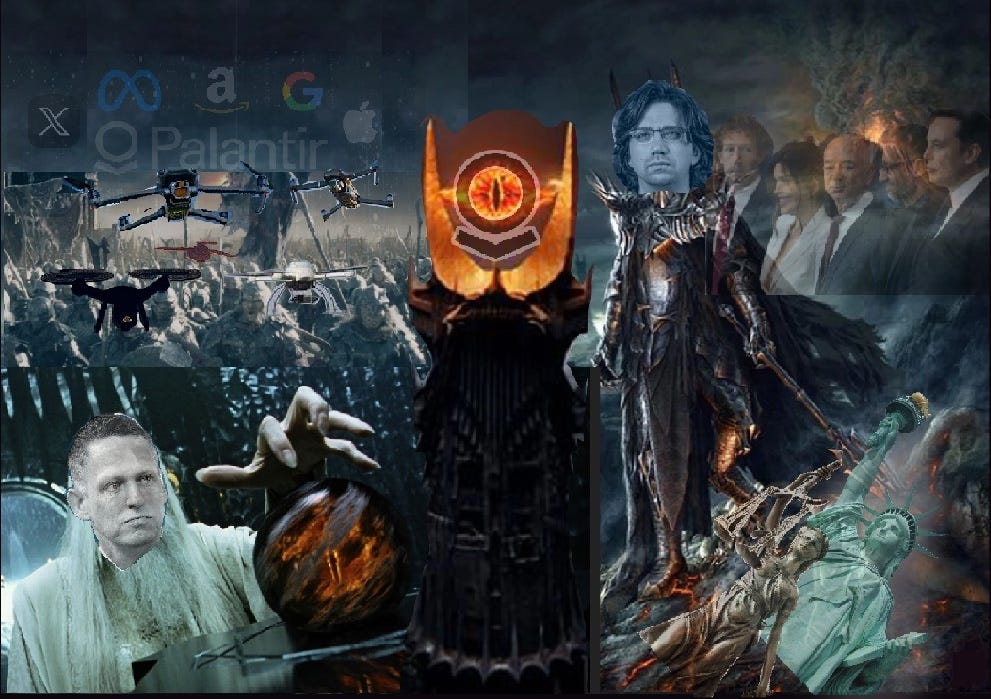
Thiel(ism), the most dangerous of all, pretends to warn us about the very thing (Antichrist) he is attempting to create. The world has entered a new paradigm, one that most do not yet recognize, because of its technical complexities and pseudo-philosophical ideologies. It's critical that we not fear to say the "crazy" things out LOUD. We are now confronted with Neoliberalism on steroids -- it's called Authoritarianism.
Excellent work!